The Monopoly Project
In summer 2025 I offered one of my original paintings, Face Value, for £10,000 in Monopoly money.
2 min read
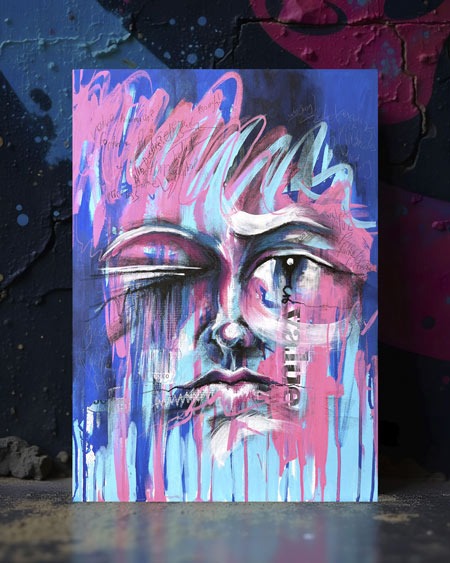
In summer 2025 I offered one of my original paintings, Face Value, for £10,000 in Monopoly money.
Not as a joke, but as an experiment about art, value, and who gets to decide what something is worth.
The winning bid came from Zoe Tuffen, who reimagined my painting with Monopoly notes spilling from its mouth, alongside a letter that made me laugh.
Face Value is now officially sold for Monopoly money.
The story behind the project
This idea sparked when I saw that Monopoly was releasing a new cashless version in August 2025. It made me think about value in the art world.
How can a banana taped to a wall sell for over $6 million because critics say it is worth that, while so many artists struggle to sell originals or even prints? It is the Emperor’s New Clothes in a banana skin.
So I thought, why not let people spend their old Monopoly cash on my painting?
By saying out loud, “This painting is worth £10,000,” I was testing what happens when an artist decides their own value publicly, without waiting for a gallery, a critic, or an algorithm. It was part visibility experiment, part self-belief exercise, and part fun.
The Bids
The responses came in from across the UK. People sent poems, quirky letters, bananas, original artworks, and even a reworked painting stuffed with Monopoly notes.
Some bids were funny, some heartfelt, some clever, and some very quirky. The project became as much about the creativity of the responses as the painting itself.
The Painting
My art is not mainstream. I like to do things differently.
This piece is mixed media on deep-edge canvas, A2 size (42 x 59.4 cm).
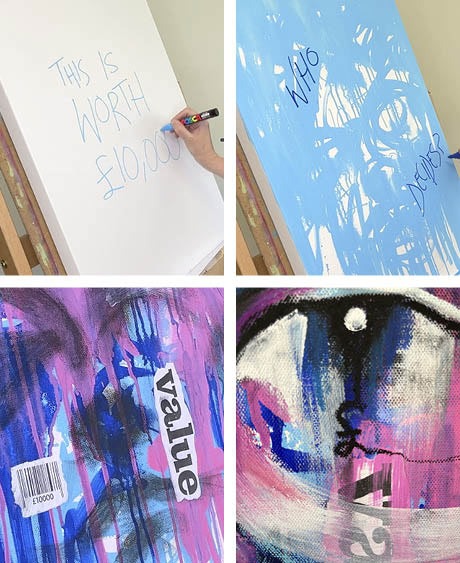
I started by painting “This is worth £10,000” directly onto the canvas.
Then I added the question, “Who decides?”
I collaged a barcode with £10,000 underneath, and the word value on one side.
A pound sign falls from one of the eyes.
Press and Coverage
I reached out to press to share the project, and it got picked up. I was interviewed twice on BBC Radio Northampton, and the story was featured on the BBC News website for Northamptonshire.
I also ended up on a community radio station, not quite prime airtime but all an experience.
The coverage gave the project a wider audience and showed that playful experiments in value can spark conversations and creativity.